March 2027 Hindu Calendar
Welcome All! The March 2027 Hindu Calendar with holidays (मार्च 2027 हिंदू कैलेंडर) Free pdf can be downloaded here.
March 2027 Hindu Calendar: March 2027 Hindu Calendar, with each Vrat (व्रत) and festival listed together, be useful to you? Yes, here we give the calendar for the month along with the full list of festivals, vrats and holidays. The March 2027 holidays calendar PDF is given below on this page.
The मार्च हिंदू कैलेंडर 2027 runs through Phalguna and the first Paksha of Chaitra. It covers the Ekadashi (एकादशी) vrats, Purnima (पूर्णिमा), Amavasya (अमावस्या) and Pradosh, along with Mahashivratri (महाशिवरात्रि), Holika Dahan (होलिका दहन), Holi (होली) and Sheetala Ashtami. The date of each one is in the table below.
March 2027 Hindu Calendar
Here is Hindu Calendar 2027 March Image you can check and read all like Holidays, Festivals and all.
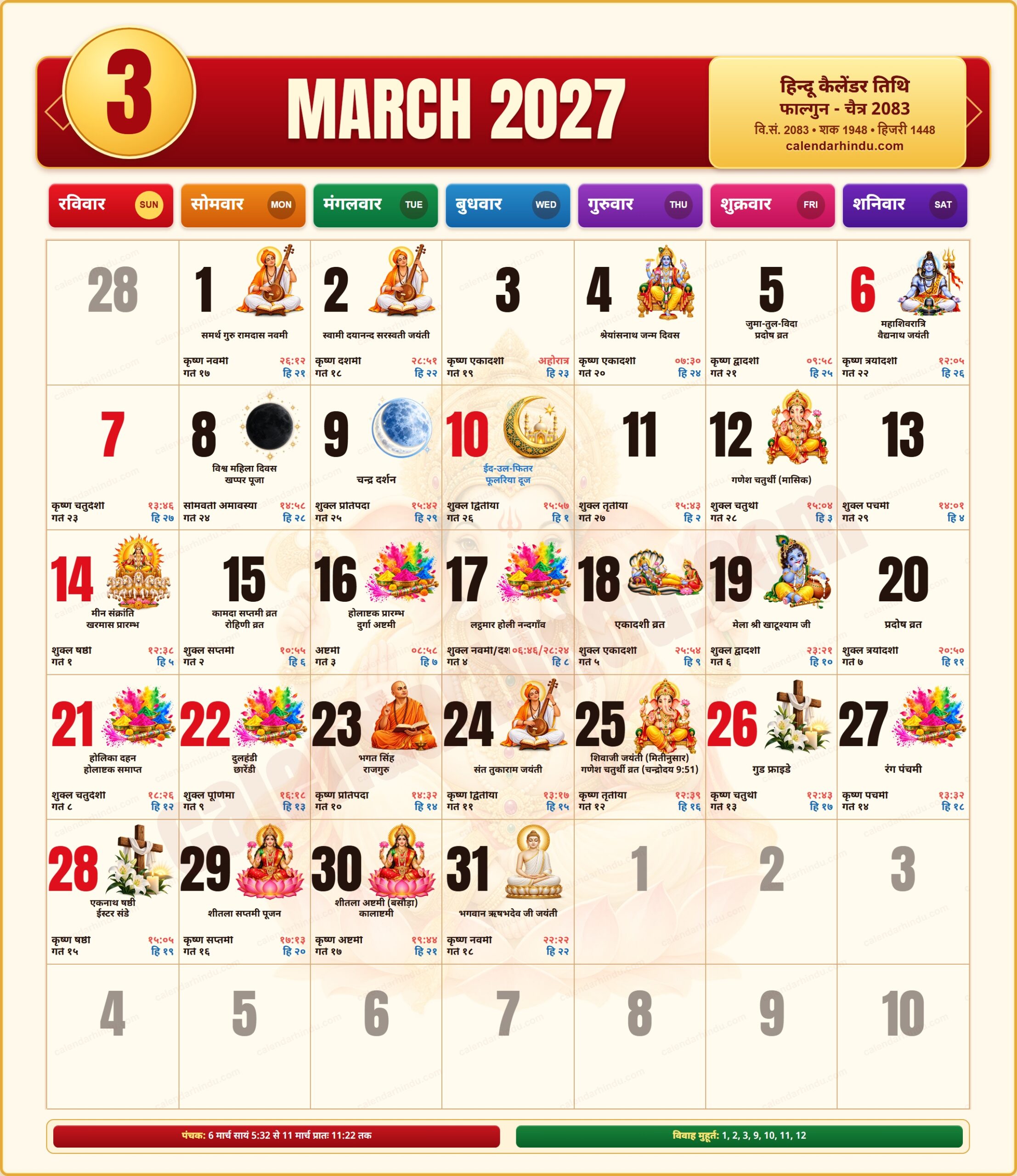
Hindu Calendar Festivals, Vrat, Important Date in March 2027
I’ll organize all the information from the March 2027 Hindu Calendar Festivals, Vrat, Important Date text into a comprehensive day-by-day table format:
| Date | Day | Holiday / Festival Name | Type |
|---|---|---|---|
| 1 March | Monday | Samarth Guru Ramdas Navami | Observance |
| 2 March | Tuesday | Swami Dayanand Saraswati Jayanti | Jayanti |
| 4 March | Thursday | Vijaya Ekadashi Vrat, Shri Shreyansnath Ji Janma Diwas | Ekadashi |
| 5 March | Friday | Pradosh Vrat, Jumat-ul-Vida | Pradosh |
| 6 March | Saturday | Mahashivratri Vrat, Vaidyanath Jayanti | Festival, Vrat |
| 8 March | Monday | Somvati Amavasya, Khappar Puja, International Women’s Day | Amavasya |
| 9 March | Tuesday | Chandra Darshan | Observance |
| 10 March | Wednesday | Phulera Dooj, Eid-ul-Fitr, Shri Ramakrishna Paramahamsa Jayanti | Festival, Jayanti |
| 12 March | Friday | Masik Ganesh Chaturthi | Vrat |
| 14 March | Sunday | Meena Sankranti, Kharmas begins | Sankranti |
| 15 March | Monday | Kamada Saptami Vrat, Rohini Vrat | Vrat |
| 16 March | Tuesday | Holashtak begins, Masik Durga Ashtami, Lathmar Holi (first day) | Observance, Vrat |
| 17 March | Wednesday | Lathmar Holi (second day) | Festival |
| 18 March | Thursday | Amalaki Ekadashi Vrat | Ekadashi |
| 19 March | Friday | Govind Dwadashi, Shri Khatu Shyam Ji Mela | Observance |
| 20 March | Saturday | Pradosh Vrat | Pradosh |
| 21 March | Sunday | Holika Dahan, Holashtak ends, Phalguna Chaumasi Chaudas (Jain) | Festival |
| 22 March | Monday | Holi (Dulhandi), Purnima Vrat, Snan-Daan Purnima, Chaitanya Mahaprabhu Jayanti | Festival, Purnima |
| 23 March | Tuesday | Shaheed Diwas (Bhagat Singh, Rajguru, Sukhdev) | Observance |
| 24 March | Wednesday | Sant Tukaram Jayanti | Jayanti |
| 25 March | Thursday | Ganesh Chaturthi Vrat, Shivaji Jayanti (by Tithi) | Sankashti Chaturthi, Jayanti |
| 26 March | Friday | Good Friday | Observance |
| 27 March | Saturday | Rang Panchami | Festival |
| 28 March | Sunday | Eknath Shashthi, Easter Sunday | Observance |
| 29 March | Monday | Sheetala Saptami Pujan | Vrat |
| 30 March | Tuesday | Sheetala Ashtami (Basoda), Kalashtami | Festival, Vrat |
| 31 March | Wednesday | Bhagwan Rishabhdev Ji Jayanti | Jayanti |
These dates follow the Tithi present at sunrise, known as Udaya Tithi. A festival can therefore shift by a day depending on the place and the sampradaya followed.
Major March 2027 Festivals Explained
Vijaya Ekadashi – 4 March
Vijaya Ekadashi, the Ekadashi of Phalguna Krishna Paksha, is listed on Thursday, 4 March. Amanta regions count it under Magha Krishna Paksha.
This time the Ekadashi Tithi is long. It covers the whole of the previous day and is still present at sunrise on Thursday, and the vrat is placed on the second day. If the tradition followed at home differs, check a local Panchang.
According to tradition, Lord Ram kept this vrat before crossing the sea, which is where the name “Vijaya” comes from. Vishnu puja and a grain-free day are the usual practice.
Mahashivratri – 6 March
The biggest night of Shiva worship falls on Saturday, 6 March. Trayodashi of Phalguna Krishna Paksha ends around midday and Chaturdashi is present through the night, which is what decides Mahashivratri.
Devotees fast through the day and offer water, milk and bel patra on the Shivling. Many stay awake at night, with puja repeated in each of the four prahars. For the night puja timings in your city, check a local Panchang.
Winter is on its way out by now, and ber, the season’s fruit, is a traditional offering. Thandai and fruit are common for those keeping the vrat.
Somvati Amavasya – 8 March
Phalguna Amavasya lands on a Monday this year, 8 March, so it is observed as Somvati Amavasya. A new moon on a Monday does not come often, which is why people look out for it.
Married women traditionally walk around a peepal tree and tie a thread on it. A bath in a river, tarpan for ancestors and daan are the other customs of the day.
Amalaki Ekadashi – 18 March
Phalguna Shukla Ekadashi is on Thursday, 18 March, just a few days before Holi. Its name comes from the amla tree, which is worshipped on this day along with Lord Vishnu.
In some temple towns it is also called Rangbhari Ekadashi, and the first colours of Holi are offered to the deity. Holashtak, the eight days before Holi when new beginnings are traditionally avoided, is already running by then.
Holika Dahan – 21 March
The bonfire night is Sunday, 21 March. Chaturdashi ends that evening and Purnima of Phalguna begins, so the fire is lit the same night, and Holashtak ends with it.
People gather around a pile of wood and cow-dung cakes, offer new wheat ears and gram to the fire, and walk around it. The story remembered is that of Prahlad and Holika. For the Holika Dahan Muhurat and Bhadra timings, check a local Panchang.
Holi – 22 March
Colours are played on Monday, 22 March, the day of Phalguna Purnima. The Panchang calls it Dulhandi, and the Purnima Vrat and snan-daan fall on the same day.
Mornings are for gulal and water, afternoons for gujiya, dahi vada and visiting neighbours. Chaitra begins the next day in the Purnimanta system. Where the custom is followed, colours come out once more on Rang Panchami, Saturday, 27 March.
Sheetala Ashtami (Basoda) – 30 March
Eight days after Holi comes Basoda, on Tuesday, 30 March. It is the Ashtami of Chaitra Krishna Paksha, which Amanta regions call Phalguna Krishna Paksha.
Mata Sheetala is worshipped, and the chulha is traditionally not lit that day. Food is cooked the previous evening, on Sheetala Saptami, and eaten cold. Some communities keep the main puja on Saptami itself, according to regional custom.
Vrat Rules, Food and Precautions for March 2027
Rules for fasting are a matter of home tradition and sampradaya, so no single list fits everyone. The vrats in the मार्च हिंदू कैलेंडर 2027 come as winter gives way to spring, with cool mornings and warm afternoons.
Commonly chosen vrat foods:
- Fruit such as ber, banana, grapes and oranges
- Milk, curd, thandai and makhana
- Sabudana khichdi, kuttu or singhara atta, sweet potato
- Sendha namak in place of ordinary salt
- Amla in any form on Amalaki Ekadashi
- Lemon water or coconut water on warmer days
Foods traditionally avoided:
- Rice, wheat and other grains on Ekadashi and Mahashivratri
- Pulses and beans on Ekadashi
- Onion and garlic on vrat days
- Ordinary salt on a phalahar vrat
- Freshly cooked hot food on Basoda, where that custom is followed
Practical precautions:
- Children, pregnant women, older adults and people with health conditions may keep a lighter vrat or consult their doctor first.
- Avoid bhang and overly rich thandai, especially on an empty stomach.
- Keep children and loose clothing at a safe distance from the Holika fire.
- Use herbal or good-quality gulal, and apply oil on skin and hair before playing.
- Store Basoda food covered in a cool place overnight, and skip anything that smells off.
- Carry a light shawl for night-long Shivratri puja, as late hours can still be chilly.
- Put used flowers and bel patra in soil or a compost pit after puja.
Puja Vidhi for Major March 2027 Observances
Mahashivratri
The night is given to Lord Shiva, and even a single lota of water offered with attention is considered enough. Some homes do one puja in the evening, others all four through the night.
Samagri: clean water or Gangajal, raw milk, curd, honey, bel patra, dhatura, ber, white flowers, chandan, dhoop and a diya.
Puja Vidhi:
- Bathe in the morning and take the sankalp for the vrat.
- Offer water on the Shivling, then milk, curd and honey.
- Rinse again with clean water and apply chandan.
- Place bel patra, flowers and fruit.
- Light the diya and chant “Om Namah Shivaya.”
- Open the vrat the next morning after a simple puja.
Holika Dahan
The fire stands for the burning away of ill will before the day of colours. Most neighbourhoods have a common bonfire, though some homes light a small one in the courtyard.
Samagri: a lota of water, roli, akshat, raw cotton thread, whole turmeric, flowers, gulal, new wheat ears, gram and a coconut.
Puja Vidhi:
- Stand facing the Holika pile and sprinkle a little water.
- Offer roli, akshat, flowers and turmeric.
- Wind raw thread around the pile, three or seven times.
- Once the fire is lit, offer wheat ears, gram and coconut.
- Walk around the fire and apply a little gulal to elders.
Sheetala Ashtami
Mata Sheetala is traditionally worshipped for protection from seasonal illness as the weather changes. The whole puja is done with cold offerings.
Samagri: food cooked the previous evening such as sweet rice, puri and gulgule, along with curd, cold water, roli, haldi, mehndi and flowers.
Puja Vidhi:
- Cook all the food the evening before and keep it covered.
- Bathe with cool water early on Ashtami morning.
- Offer cold water, roli and haldi to Mata Sheetala.
- Place the food and curd as bhog.
- Read the Sheetala Mata katha and share the prasad.
Frequently Asked Questions
Which calendar system is used for March 2027?
We have followed the North Indian Purnimanta system. In Amanta regions the dates stay the same, but each Krishna Paksha is counted under the previous month’s name.
Why can the same festival have two different dates?
A Tithi can stretch across two sunrises, and traditions may choose differently. Vijaya Ekadashi this month is one such long Tithi, listed on 4 March.
When are the main Ekadashi vrats in March 2027?
Vijaya Ekadashi is on Thursday, 4 March, and Amalaki Ekadashi is on Thursday, 18 March.
Are Panchang and Muhurat timings the same in every city?
No, sunrise and moonrise depend on location. The Ganesh Chaturthi moonrise on 25 March is listed as 9:51, so confirm it in your local Panchang.
How should I use the March 2027 calendar PDF?
Print the मार्च हिंदू कैलेंडर 2027 PDF and keep it where it is easy to see. Mark Shivratri, Holi and the vrat days ahead of time.
Conclusion
In this article we have given the Hindu calendar for the month of March 2027. We have also told when the festivals and vrats fall in March, in a complete table format, along with the holidays. If this article was helpful, do share it with friends and relatives. On our site you can also read the calendars for the other months, the Panji and the horoscope for all zodiac signs. Thank you for visiting.